Factory Resets of Governance Rules
Democracy FOR the People
A manager's business plan to reset every organ of the Indian State.
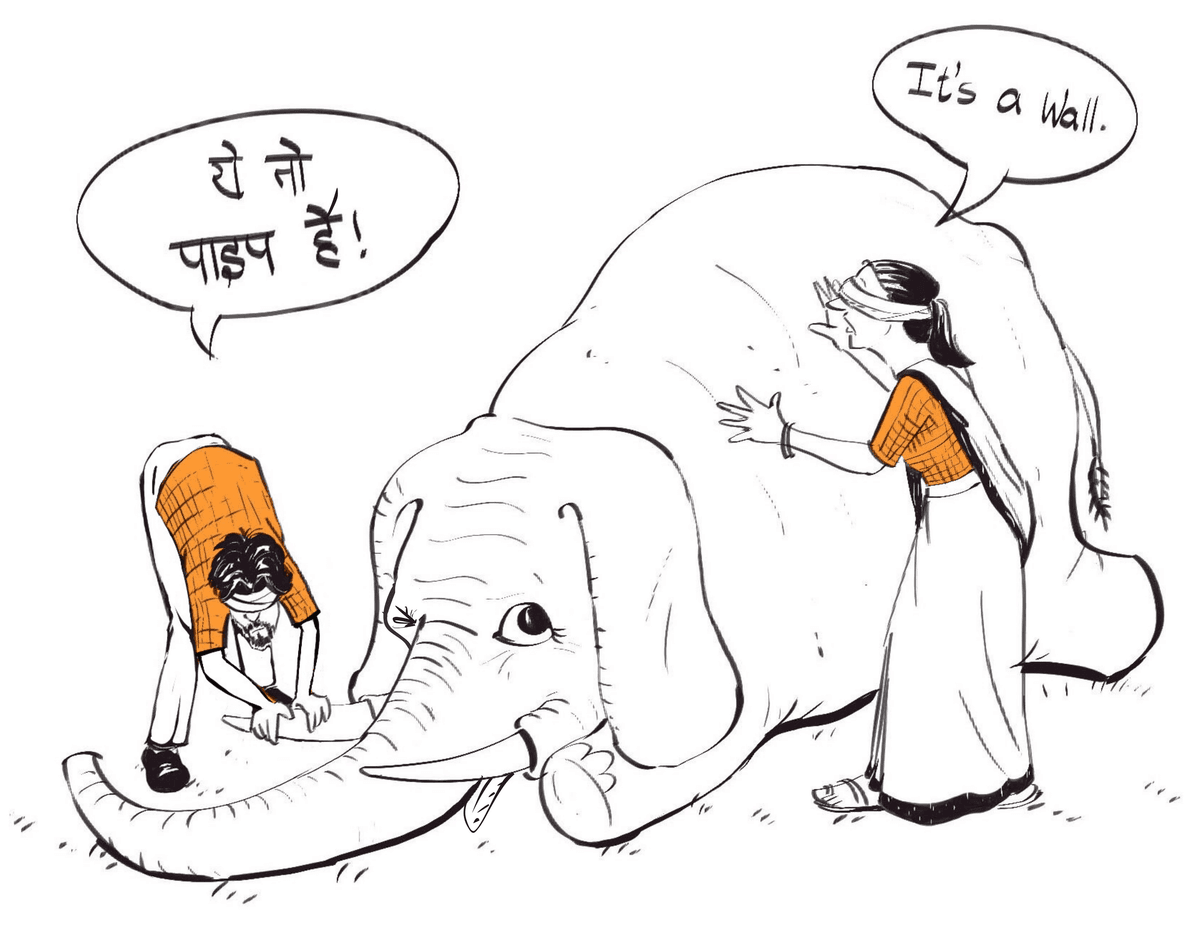
The author’s “Dots.” Like the blind men, each of us grasps only one part of the governance elephant. Reform needs the whole animal — not one man’s certainty.
The Premise
Like the proverbial blind men, each of us can grasp only a part of the world — only a part of the elephant.
This is a business plan: a manager's attempt to reset the governance architecture towards the constitutional goal — Dignity of the Individual & Unity of the Nation.
For the last 2,500 years, as per Plato, we the people have been waiting for a philosopher to become a king, or a king to become a philosopher, for our ordinary concerns to become central to governance.
The body of work on Management has grown exponentially in the last 60 years. This is a business plan that develops the governance rules — Good Governance Practices (GGP) — to ensure that our concerns are central to the governance.
The Manager's Toolbox
01. Structures
Defines the hierarchy, reporting lines and the distribution of roles and responsibilities within an organization, to execute processes efficiently with least administrative friction.
02. Systems
Interrelated processes and resources are grouped together logically to manage inputs and produce desired outputs.
03. Processes
Processes drive systems, through a predefined, repeatable sequence of tasks designed to achieve outcomes, as specified (at that time).
04. Incentives
Pay, bonuses and recognition are designed to motivate incumbents to perform the assigned role with integrity.
The Seeker's Tool 4W + 1H
- What
- Why
- Where
- When
- How
The Reset : Chapters
The three organs of the State, the Fourth Pillar and the Citizens.
Tap any row to read the reset
The bulwark against Matsya Nyaya — the Dharma of Governance is Protection of the Weak. Justice, Liberty and Equality are the instrumentalities to achieve the goal of the Republic: "DIGNITY of the INDIVIDUAL & UNITY of the NATION".
"There are no good or bad leaders — only people acting on the incentives they're given." Reform must redesign the framework, never moralize about corrupt individuals.
"India is a 30-foot lake. Governance stirs only the top 5–6 feet." The bottom lives dark, drudgery, nasty and short — as it has for centuries. But over the last 75 years we have made massive strides: in 1950 only about 60mn of us were literate (17%); today about 1,100mn (80%) of us are literate.
Most of the elected persons, the cream of society, are compelled to work for personal gains and to provide for the next election. Cut the cost to the candidate to a minuscule level and still conduct elections efficiently — our representatives are then free to express and address our needs.
Parliament has 6 cardinal functions, not just law-making. Split every Sabha into three groups — Executive, Opposition, Neutral. All laws must go through a Permanent Parliamentary Committee (PPC) and must be tested for Justice, Liberty and Equality.
All subjects must be represented in the Cabinet, the highest decision-making body of the country. Sixteen Mahamantralaya are conceived as Strategic Constitutional Units (SCU), with the Prime Minister first among equals. The same 16 are replicated at state, district and taluka level to streamline communication and service delivery.
Most of our districts are, population-wise, as big as small countries — Sweden, New Zealand. So the District CEO is assisted by 16 Mahamantralaya officers, and by a Superintendent of Police with two wings: Jan Rakshak, who patrol, and an investigating division.
The District Governance Council is a coordinating body where the elected and the selected coordinate their work and hold quarterly review meetings on progress against targets. Such meetings are attended by the Press and the Public.
Judicial administration realigned on the principle of queuing theory. Every complaint of every citizen or legal entity is made at the local panchayat only; the docket then moves up to taluka, district court, High Court and Supreme Court. Each case is heard by a five-person bench at every level — no single-judge courts. "Remediable injustices" are to be sorted out within one year, under ₹25,000. No prisoner remains in prison beyond 90 days, within which the charges must be framed; electronic and economic arrest systems must be used.
Panchayats must be empowered to become the most proximate unit of governance service delivery. Three lakh panchayats, each serving about 500 people — some 1,200–1,500 households — ensuring community connect and better services. The panchayat complex houses an administrative unit, a police post, a bank and post office, a municipal services unit, and above all a unit to ensure execution of court orders, awards and judgements.
Media is the means to have conversation and discussion at community and population scale. Every group — a political party, an NGO, even a family — pushes for its agenda; that is lobbying. Media owners and editors have an equal right to lobby. Self-regulating groups of editors and publishers are formed at every level, assigning a credibility rating to a newspaper organisation and to an article, akin to the credit rating systems used by financial markets.
A 3 kg ± humanimal (ह्युमनिमल), born within the boundaries of the Indian nation, must be trained in democratic values, and in the rights and responsibilities set out in the Constitution.
The Outcome
The Factory Resets will bring about a peaceful and imperceptible “Revolution” in the Indian Republic by turning the Governance focus 180 degrees: from Command & Control to People-Centric—the essence of Ram-Rajya!
Just as “Prudent Management” turns a loss-making Company to profits, People-Centric Governance will reduce the Tax Intensity from 17% ± to 15% ±.
The Blog
Vidha — the argument, continued
Application of The Seekers Tool - 4W+1H on various issues of management / governance since 2012
Drag to rotate
“Your Dots & Thoughts — To devise your own Resets.”
Know More
Write to us
Questions about the resets, an invitation to speak, or a copy for review — send a note and it reaches the author directly.
You can also find the book on Amazon.in and StoryMirror.